Article: How to Apply Sunscreen on a Baby's Face (Without Tears)

How to Apply Sunscreen on a Baby's Face (Without Tears)
Baby sunscreen for the face should be applied gently and evenly to clean, dry, exposed skin, while keeping it away from the eyes, lips, and inside the nose. Use an age-appropriate, broad-spectrum sunscreen, follow the baby products label for the amount, and reapply as directed. Shade, hats, and protective clothing should complement sunscreen.
Applying baby sunscreen for the face is easiest when you use a small amount at a time, work in sections and keep the routine calm. Little Rituals makes everyday baby skincare simpler with gentle sun-care and skin-care essentials designed for delicate skin. Keep reading for a tear-free application routine you can actually follow.
Can You Use Baby Sunscreen on Your Baby's Face?
Yes, sunscreen can be used on exposed facial skin when it is appropriate for your baby's age and the product's instructions. For babies younger than 6 months, the priority is shade, protective clothing, and avoiding direct sun exposure. If adequate shade and clothing are unavailable, a small amount of sunscreen may be used on exposed areas according to appropriate guidance.
For babies 6 months and older, use a broad-spectrum sunscreen on uncovered skin and follow the product label carefully. Mineral sunscreen containing zinc oxide or titanium dioxide can be a suitable option for sensitive baby skin.
The goal is not to cover your baby's face with a thick layer. It is to create an even layer over the exposed skin without getting the product into the eyes or mouth.
What to Do Before Applying Baby Sunscreen for Face
A little preparation can make sunscreen application much easier.
1. Start With Clean, Dry Skin
Clean your baby's face gently and allow it to dry before applying sunscreen. Avoid applying sunscreen over sweat, dirt, or food residue where possible.
2. Moisturise If Needed
If your baby's skin needs extra moisture, apply a gentle moisturiser first and allow it to settle before sunscreen.
Little Rituals Postbiotic Face Cream is designed as a daily moisturiser for delicate skin. Its lightweight formula helps hydrate the skin and support the skin barrier. The product is also clinically and dermatologically tested.
Think of the routine as:
Cleanse → Moisturise if needed → Sunscreen → Hat and protective clothing
3. Patch Test a New Product
When introducing a new sunscreen, patch test it according to the product instructions. Little Rituals recommends patch testing its sunscreen products, particularly for babies and sensitive skin. Stop using a product if irritation develops.
How to Apply Baby Sunscreen for Face Step by Step
The easiest approach is to divide the face into small areas rather than trying to cover everything at once.
Step 1: Choose an Age-Appropriate Sunscreen
Look for:
- Broad-spectrum UVA and UVB protection
- An SPF appropriate for your baby's age and the product instructions
- Water resistance when relevant
- A formula designed for babies, children or sensitive skin
- Clear application and reapplication instructions
For babies and toddlers, mineral filters such as zinc oxide or titanium dioxide are often preferred because they are less likely to irritate sensitive skin. Explore What Age Can Babies Start Using Sunscreen? Pediatrician-Backed Guide to learn about age-appropriate sun protection, baby-safe sunscreen options, and ways to protect your little one’s delicate skin from harmful UV rays.
Little Rituals offers Ray Guard Mineral Sunscreen, a mineral-based formula using non-nano zinc oxide and broad-spectrum UVA/UVB protection. It is also water-resistant and suitable for babies, kids and families.
Step 2: Apply the Sunscreen to Your Fingers First
Do not squeeze a large amount directly onto your baby's face.
Instead:
- Dispense a small amount onto clean fingertips.
- Add more gradually as needed.
- Work in small sections.
- Spread it into an even layer.
There is no single pea-sized quantity that works for every baby's face or every sunscreen formulation. Follow the amount recommended on your product label and make sure all exposed skin receives an even layer.
Step 3: Start With the Cheeks
Gently spread sunscreen across one cheek using light strokes.
Then repeat on the other cheek.
Avoid vigorous rubbing. If your baby dislikes the sensation, use short, gentle touches rather than repeatedly rubbing the same area.
Step 4: Cover the Forehead
Apply a small amount across the forehead, working gently from the centre outwards.
Be particularly careful around the eyes. Sunscreen should not be applied directly into the eyes.
Step 5: Don't Forget the Nose
The nose is an exposed area that is easy to miss.
Use a small amount and gently spread it across the bridge and sides of the nose while keeping the product away from the nostrils.
Step 6: Protect the Ears
The ears are often forgotten during sunscreen application.
Cover the exposed parts of:
- The tops of the ears
- The front of the ears
- Behind the ears when exposed
Step 7: Apply to the Neck
If your baby's neck is exposed, gently cover the front and sides.
Remember that sunscreen should be applied to exposed skin, not simply to the areas you can see most easily.
How Much Baby Sunscreen Should You Use on the Face?
The right amount depends on your baby's facial size and the specific sunscreen. Rather than relying on a fixed household measurement, use enough to form a thin, even layer across all exposed facial skin and follow the product's directions.
For easier application, divide the face into sections:
|
Area |
Application approach |
|
Cheeks |
Small amount, spread evenly |
|
Forehead |
Thin, even layer |
|
Nose |
Small amount, carefully spread |
|
Ears |
Cover exposed areas |
|
Neck |
Cover exposed skin |
|
Eye area |
Avoid direct contact |
For baby sunscreen, applying gradually is usually easier than putting one large amount on your baby's skin at once.
How to Apply Baby Sunscreen Without Tears
The sunscreen itself is only half the battle. The other half is getting your baby to cooperate.
Keep the Routine Short
Have everything ready before you begin:
- Sunscreen
- A hat
- Protective clothing
- Wipes or a damp cloth
- A favourite toy
This keeps you from searching for things while your baby is already getting impatient.
Apply It in Sections
Try:
Cheeks → Forehead → Nose → Ears → Neck
You do not need to complete the entire face in one dramatic application.
Distract Your Baby
Give your baby something interesting to hold or look at while you apply the sunscreen.
A familiar toy, book or playful song can turn the routine into something predictable rather than frustrating.
Apply Before You Leave
Do not wait until you are standing in bright sunlight with a wriggling baby.
Apply sunscreen before heading outside, following the product's recommended timing. Many children's sun-care recommendations advise applying sunscreen before outdoor exposure.
Never Spray Sunscreen Onto Your Baby's Face
If you use a spray sunscreen, never spray it directly onto your baby's face. Sprays should not be inhaled, and applying sunscreen to your hands first gives you better control around the face.
When Should You Reapply Baby Sunscreen?
Reapplication matters because sunscreen can wear away through sweating, swimming, rubbing and towel drying.
When your baby is outdoors, reapply approximately every two hours or according to the product label. Reapply sooner after swimming, sweating or wiping the face.
Check areas that babies commonly rub, especially:
- Nose
- Cheeks
- Around the mouth
- Forehead
- Ears
If sunscreen has visibly rubbed away, don't simply assume the original application is still providing complete coverage.
What If Sunscreen Gets Into Your Baby's Eyes?
It happens. The important thing is to stay calm.
If sunscreen gets into your baby's eyes:
- Stop applying the product.
- Gently clean the surrounding area.
- Follow the product's first-aid instructions.
- Seek medical advice if significant or persistent irritation develops.
To prevent it in the first place, avoid applying sunscreen directly to the eyelids and keep the product away from the immediate eye opening.
7 Common Baby Sunscreen Mistakes to Avoid
Even with a good sunscreen, application mistakes can reduce coverage.
Avoid these common problems:
- Applying only to the cheeks and forgetting the forehead, ears or neck.
- Using too little product to cover exposed skin evenly.
- Applying directly around the eyes where it can easily migrate.
- Forgetting to reapply after sweating, swimming or wiping.
- Using a product that is not age-appropriate.
- Relying only on sunscreen instead of using shade and protective clothing.
- Turning application into a struggle by repeatedly chasing a moving baby with sunscreen.
A calm routine is easier for both parent and child.
Don't Rely on Sunscreen Alone
Sunscreen is one layer of sun protection, not the entire strategy.
For babies, especially younger infants, combine sunscreen where appropriate with:
- Shade whenever possible
- Lightweight, protective clothing
- Long sleeves and trousers when practical
- A wide-brimmed hat
- A stroller canopy or sunshade
- Avoiding prolonged direct sun exposure
The American Academy of Dermatology recommends shade and protective clothing as important ways to protect babies from the sun.
For babies younger than 6 months, keeping them out of direct sunlight is especially important.
Little Rituals Baby Sun-Care Essentials
A simple routine becomes easier when the baby care products you use fit naturally into it.
Ray Guard Mineral Sunscreen
Ray Guard Mineral Sunscreen uses non-nano zinc oxide and is formulated for babies, kids and families. It offers broad-spectrum UVA and UVB protection, is water-resistant and has a lightweight, non-greasy texture.
It can be part of your everyday outdoor routine when sunscreen is appropriate for your child's age.
Ray Shield Sunscreen
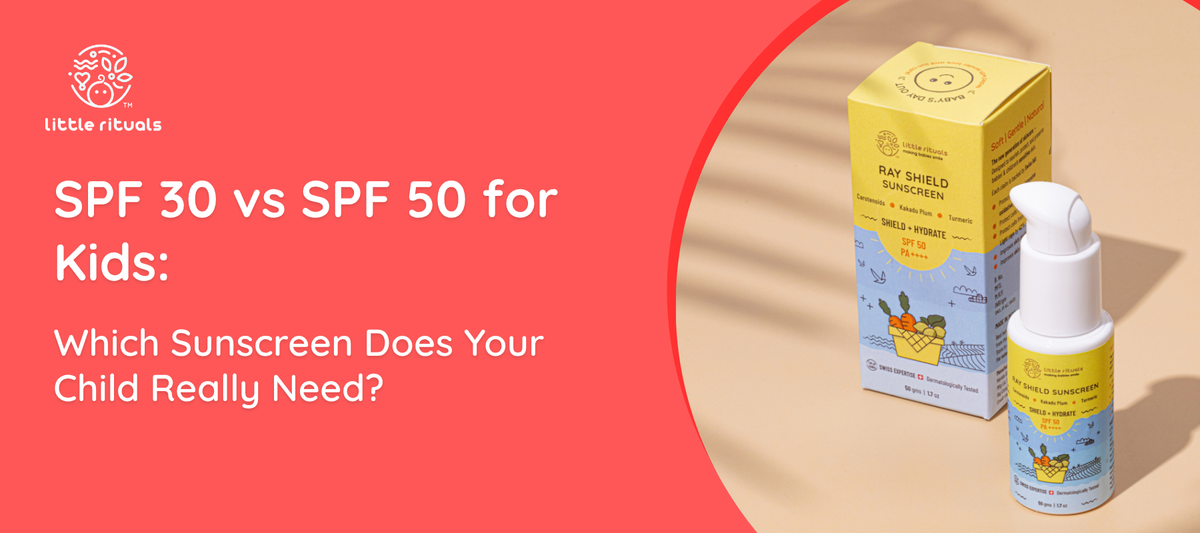
Ray Shield Sunscreen provides broad-spectrum UVA/UVB protection and is designed for delicate skin. Little Rituals describes it as a fast-absorbing, reef-safe formula suitable for babies from 3+ months. Always follow the product label and your child's individual needs when choosing a sunscreen.
Postbiotic Face Cream
For babies who need daily facial moisturisation, Postbiotic Face Cream can be used as the moisturising step before sunscreen. It is formulated to hydrate delicate skin and support the skin barrier.
Mini Travel Kit With Bag
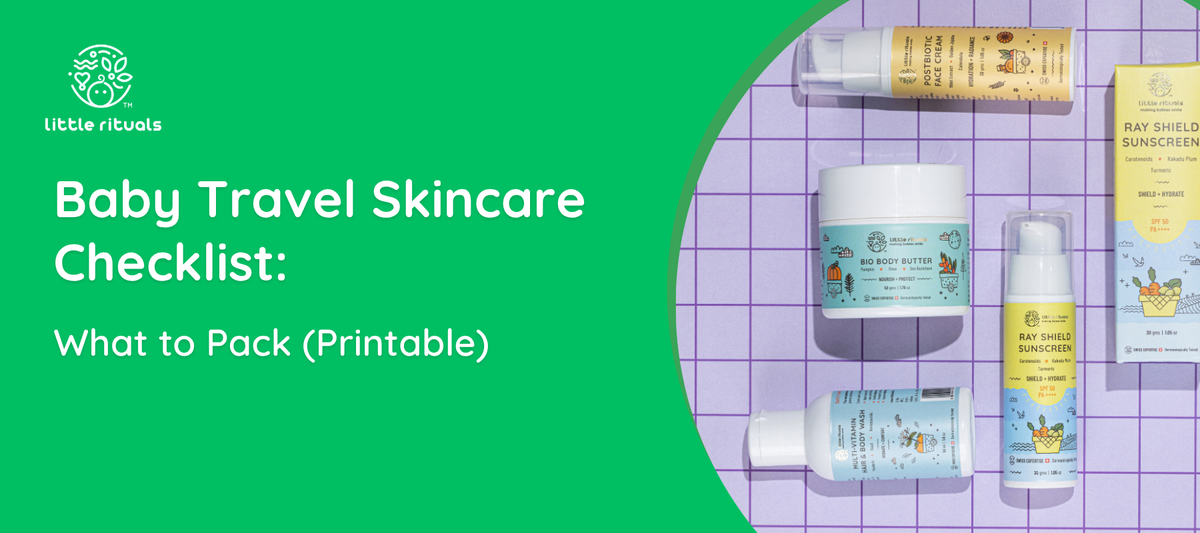
For family outings and travel, the Little Rituals Mini Travel Kit brings together everyday care essentials, including Ray Shield Sunscreen, Postbiotic Face Cream, Bio Body Butter and Multi-Vitamin Hair & Body Wash.
Baby Sunscreen for Face: Quick Checklist
Before heading outdoors, run through this simple checklist:
- Check the sunscreen's age suitability.
- Start with clean, dry skin.
- Moisturise first if needed.
- Apply sunscreen to your fingertips.
- Cover cheeks and forehead.
- Don't forget the nose and ears.
- Cover exposed neck skin.
- Keep sunscreen away from the eyes and mouth.
- Add a hat and protective clothing.
- Stay in the shade whenever possible.
- Reapply according to the product directions.
A consistent routine is more useful than trying to make every application perfect.
Make Sun Protection a Little Ritual
Baby skincare does not need to become another stressful part of your day. With the right order, a gentle touch, and a little patience, applying sunscreen can become a simple routine before every outdoor adventure.
From Ray Guard Mineral Sunscreen and Ray Shield Sunscreen to Postbiotic Face Cream and everyday baby-care essentials, Little Rituals brings together thoughtfully formulated products for your little one's routine. Explore the Little Rituals baby sun-care collection and make gentle protection part of your everyday ritual.
FAQs
Q1. How do I apply baby sunscreen for face without making my baby cry?
Apply a small amount at a time using your fingertips. Work in sections: cheeks, forehead, nose, ears, and neck, and distract your baby with a toy or song. Keep sunscreen away from the eyes and avoid rubbing repeatedly over the same area.
Q2. Can I put sunscreen directly around my baby's eyes?
No. Keep sunscreen away from the eyes and eyelids. Apply carefully around the surrounding facial area so the product does not migrate into the eyes. If sunscreen gets into the eyes and irritation persists, seek medical advice.
Q3. Is mineral sunscreen suitable for a baby's face?
Mineral sunscreens containing zinc oxide or titanium dioxide are often suitable for babies and sensitive skin because these ingredients are less likely to cause irritation. Choose an age-appropriate, broad-spectrum product and follow its directions.
Q4. Will sunscreen alone protect my baby from the sun?
No. Sunscreen should be combined with shade, protective clothing and a suitable hat. For babies younger than 6 months, avoiding direct sun and using shade and protective clothing are particularly important.
Q5. What should I do if my baby rubs sunscreen off?
Check the exposed area and gently reapply sunscreen where it has been removed, following the product directions. Pay particular attention to the cheeks, nose and forehead because babies frequently touch these areas.
Q6. Why does my baby cry when I apply sunscreen?
Your baby may dislike the unfamiliar texture, smell, temperature, or sensation of the product. Apply a small amount gradually, keep the routine quick, and use distraction. Applying sunscreen before leaving home can also make the process calmer.
Q7. How often should I reapply sunscreen on my baby's face?
Reapply approximately every two hours when outdoors, or according to the sunscreen's label. Reapply sooner after swimming, sweating, or towel drying because these activities can remove sunscreen.
Q8. Can I use the same baby sunscreen on the face and body?
Many sunscreens are designed for both face and body, but always check the product label. For the face, apply carefully and avoid the eyes, lips, and inside of the nose. A formula designed for delicate skin can make facial application more comfortable.