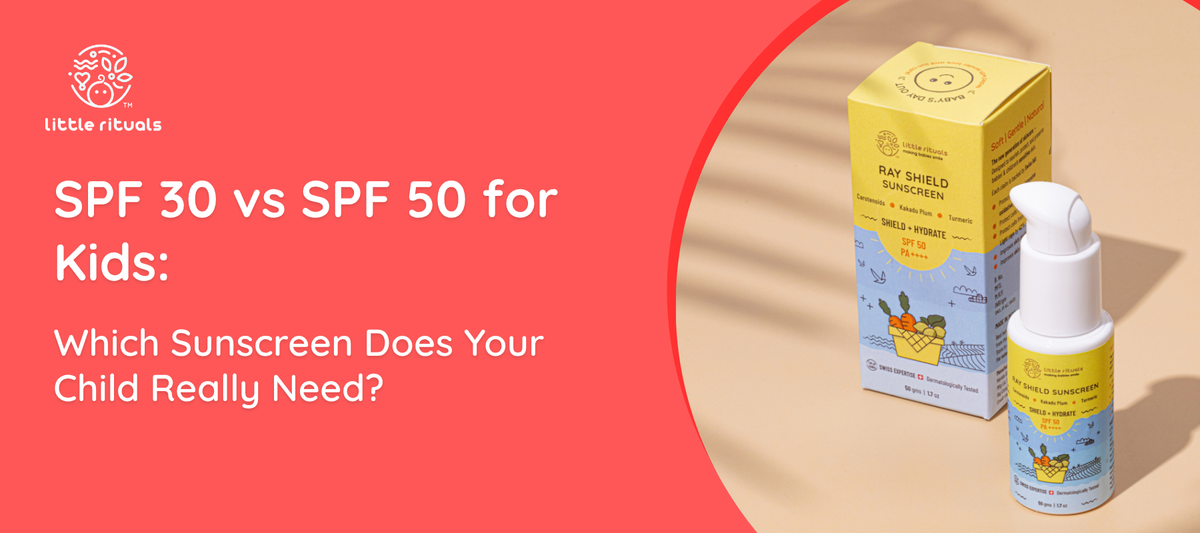
SPF 30 vs SPF 50 for Kids: Which Sunscreen Does Your Child Really Need?
SPF 30 vs SPF 50 for kids mainly differs in the level of UVB protection offered. SPF 30 provides strong everyday protection, while SPF 50 offers greater protection for prolonged or intense sun exposure. For children, choose a broad-spectrum, water-resistant sunscreen with SPF 30 or higher and apply it generously and regularly.
Children spend plenty of time outdoors, from school runs and playgrounds to family outings and holidays. That makes reliable sun protection an important part of their daily care. At Little Rituals, we make choosing kids’ sunscreen simpler with thoughtfully designed baby products for little ones. But before picking a bottle, there is one question worth understanding: what does the SPF number actually mean for your child?
SPF 30 vs SPF 50 for Kids: What Does SPF Actually Mean?
SPF stands for Sun Protection Factor and primarily indicates protection against UVB radiation, which is a major cause of sunburn. A higher SPF offers greater UVB protection, but no sunscreen blocks 100% of UV radiation. SPF 30 blocks approximately 97% of UVB rays, while SPF 50 provides somewhat greater protection.
The important point is that SPF is not a timer.
An SPF 50 sunscreen does not mean your child can stay outside 50 times longer than without sunscreen. Protection still decreases with sweating, swimming, rubbing, towel drying and insufficient application. Sunscreen also needs to be reapplied while children remain outdoors.
For parents, the practical takeaway is simple: the number on the bottle matters, but how the sunscreen is applied matters just as much.
SPF 30 vs SPF 50 for Kids: Which Offers More Protection?
When comparing SPF 30 vs SPF 50 for kids, SPF 50 provides a higher level of UVB protection than SPF 30. However, the difference is not as dramatic as the numbers might suggest.
|
Feature |
SPF 30 |
SPF 50 |
|
UVB protection |
About 97% |
Higher than SPF 30 |
|
Everyday outdoor use |
Suitable |
Suitable |
|
Extended outdoor exposure |
Good protection when applied correctly |
Useful when greater protection is desired |
|
Reapplication needed |
Yes |
Yes |
|
Broad-spectrum protection |
Should be selected |
Should be selected |
|
Water resistance |
Helpful for active children |
Helpful for active children |
Both can be appropriate choices when they provide broad-spectrum protection and are used correctly. Dermatologists generally recommend broad-spectrum sunscreen with SPF 30 or higher for children aged six months and older.
Why SPF 50 Can Be Useful for Children
Children spend considerable time outdoors, at school, in parks, on holidays, during sports, and at family outings. Their sunscreen may also wear off because of sweat, water, clothing, and frequent touching of the face.
In these situations, SPF 30 vs SPF 50 for kids becomes less about choosing a “better” number and more about choosing an appropriate level of protection that your child will actually use properly.
SPF 50 can be particularly practical when:
-
Your child spends several hours outdoors.
-
You are travelling to a sunny destination.
-
Your child participates in outdoor sports.
-
Your child sweats heavily.
-
Your child spends time around swimming pools or beaches.
-
You want a higher SPF as an added margin of protection against under-application.
However, SPF 50 does not replace shade, protective clothing or regular reapplication.
Does PA Rating Matter for Kids?
Yes. SPF mainly communicates UVB protection, while a broad-spectrum sunscreen protects against both UVA and UVB radiation. UVA exposure also contributes to long-term skin damage.
When choosing a kids’ sunscreen, look beyond the SPF number and check the label for:
-
Broad-spectrum UVA and UVB protection
-
SPF 30 or higher
-
Water resistance for active outdoor use
-
Ingredients suitable for sensitive skin
-
Clear application and usage instructions
For parents comparing SPF 30 vs SPF 50 for kids, checking the complete sunscreen label is more useful than focusing on SPF alone.
Mineral vs Chemical Sunscreen: What Should Parents Choose?
Mineral Sunscreen For Babies commonly use ingredients such as zinc oxide or titanium dioxide. These ingredients are generally less likely to irritate sensitive infant and toddler skin.
That makes mineral sunscreen an option many parents consider when choosing sun protection for young children or sensitive skin.
Little Rituals offers Ray Guard Mineral Sunscreen, formulated with non-nano zinc oxide and designed for babies, kids and families. Baby care products positioning focuses on mineral-based protection and a lightweight, clear finish.
The important consideration is not simply whether a sunscreen is labelled “mineral” or “chemical.” Parents should also consider the child's age, skin sensitivity, outdoor activity, formulation, application experience and the protection stated on the product label. Discover the difference between mineral and chemical sunscreen to understand how their ingredients work, how they protect the skin, and which type may suit your skincare needs.
What SPF Should You Choose for Different Outdoor Situations?
There is no single SPF number that every child must use in every situation.
For everyday school days
An SPF 30 or higher broad-spectrum sunscreen can provide appropriate protection when applied generously and reapplied as needed.
For outdoor sports
SPF 50 can be a practical choice, particularly when children spend extended periods outside and sweat frequently.
For holidays and beach days
Choose broad-spectrum, water-resistant sunscreen with SPF 30 or higher and combine it with shade, protective clothing and regular reapplication.
For sensitive skin
Focus on a gentle formulation and consider mineral sunscreen containing zinc oxide or titanium dioxide, which can be less irritating for sensitive infant and toddler skin.
How Much Sunscreen Should You Apply to Your Child?
One of the most common sunscreen mistakes is applying too little.
A high SPF cannot provide the protection stated on the label if only a thin layer is applied. Children need sunscreen on all exposed areas, including commonly missed areas such as the ears, neck, shoulders, hands, and tops of the feet.
A simple routine is:
-
Apply sunscreen before going outdoors.
-
Cover all exposed skin evenly.
-
Pay attention to commonly missed areas.
-
Reapply approximately every two hours when outdoors.
-
Reapply sooner after swimming, sweating, or towel drying, following the product's directions.
This is why the real question behind SPF 30 vs SPF 50 for kids is not simply “Which number is higher?” It is “Which suitable sunscreen will I apply correctly and consistently?”
Sun Protection Is More Than Sunscreen
Sunscreen works best as part of a broader sun-protection routine.
For children, combine sunscreen with:
-
Lightweight, sun-protective clothing
-
A wide-brimmed hat
-
UV-protective sunglasses
-
Shade whenever possible
-
Breaks indoors during intense sun
-
Adequate hydration during hot weather
For babies younger than six months, sun protection should primarily focus on shade and protective clothing. Sunscreen use should generally be minimised at this age, with limited use considered only when adequate shade and clothing are unavailable.
Little Rituals Sun Care for Little Ones
At Little Rituals, everyday baby care is built around gentle formulations and thoughtful routines. For parents looking for sun protection, the range includes Ray Shield Sunscreen and Ray Guard Mineral Sunscreen.
Ray Guard Mineral Sunscreen uses non-nano zinc oxide and is positioned for babies, kids and families, making it an option for parents who prefer mineral-based sun protection.
Ray Shield Sunscreen is another Little Rituals sun-care option designed around children's delicate skin.
Explore Little Rituals' sunscreen range to choose a formula that fits your child's age, skin needs and everyday routine.
Common Mistakes Parents Make With Kids' Sunscreen
Even when parents choose a suitable sunscreen, everyday habits can reduce its effectiveness.
Avoid these common mistakes:
-
Applying sunscreen only once in the morning
-
Using too little product
-
Missing the ears, neck, or hands
-
Assuming SPF 50 eliminates the need for reapplication
-
Using sunscreen without checking age suitability
-
Treating sunscreen as a substitute for shade or protective clothing
-
Forgetting sunscreen during cloudy outdoor days
Sunscreen needs to become a routine, not a one-time step before leaving home. Explore Do Babies Need Sunscreen in Winter? The Truth About Year-Round Sun Protection to learn about seasonal sun exposure, baby-safe sun protection, and ways to protect your baby’s delicate skin throughout the year.
The Bottom Line
When it comes to SPF 30 vs SPF 50 for kids, both can play a valuable role in protecting young skin. SPF 30 provides strong protection, while SPF 50 offers a higher level of UVB protection. The most important habits are choosing broad-spectrum sunscreen, applying enough, reapplying regularly and combining sunscreen with shade and protective clothing.
For parents, the goal is not simply to find the highest number on the bottle. It is to build a sun-protection routine that is appropriate, consistent and gentle enough for everyday childhood adventures.
FAQs
Q1. How often should sunscreen be reapplied on kids?
Reapply approximately every two hours while outdoors and immediately after swimming or sweating, following the product's directions.
Q2. Can SPF 30 protect kids adequately?
Yes. SPF 30 provides strong UVB protection and is generally considered an appropriate minimum for children aged six months and older when used correctly.
Q3. Is SPF 50 safer than SPF 30 for children?
SPF 50 provides higher UVB protection, but it is not automatically “safer.” Proper application, broad-spectrum coverage and reapplication are essential with either SPF.
Q4. What SPF is best for a 10-year-old child?
A broad-spectrum sunscreen with SPF 30 or higher is suitable. SPF 50 can be useful for extended outdoor activities.
Q5. Why does sunscreen need to be reapplied?
Sunscreen wears away through time, sweating, swimming, rubbing and towel drying. Reapplication helps maintain protection while your child remains outdoors.
Q6. Will SPF 50 prevent sunburn completely?
No. No sunscreen blocks all UV radiation. Sun protection also requires adequate application, reapplication, shade and protective clothing.
Q7. What should parents look for in kids' sunscreen?
Look for broad-spectrum protection, SPF 30 or higher, appropriate age guidance and water resistance when needed. For sensitive young skin, mineral ingredients such as zinc oxide or titanium dioxide may be worth considering.
Q8. Is SPF 50 necessary for every child?
No. SPF 30 or higher can provide substantial protection. SPF 50 may be preferred for prolonged outdoor exposure, but correct application and regular reapplication remain essential.